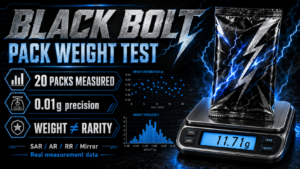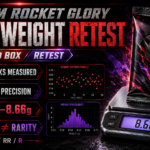

Can the rarity of a Japanese Pokémon TCG booster pack be identified simply by weighing it before opening?
To find out, I tested a full unopened booster box of The Glory of Team Rocket (ロケット団の栄光).
For this experiment, I weighed all 30 unopened packs individually using a digital scale capable of measuring to 0.01g.
After recording every measurement, I opened all 30 packs and compared the results with the SAR, AR, RR, and R cards found inside.
The results from this booster box were:
SAR: 8.68g
RR: 8.59g–8.72g
AR: 8.56g–8.73g
R: 8.60g–8.67g
The SAR and several RR cards appeared in relatively heavy packs.
However, AR cards were found across an extremely wide range, from some of the lightest packs in the box to the heaviest end of the distribution.
I also recorded different rarities at exactly the same displayed weight.
At 8.63g, for example, one pack contained an R while another contained an AR.
The overall conclusion from this booster box is:
Pack weight showed some patterns, but weight alone could not accurately identify whether a pack contained an SAR, AR, RR, or R card.
This article documents the measurements and opening results from one booster box to examine whether what is commonly known as “pack weighing” can actually distinguish card rarity.
It is not intended to encourage weighing packs in stores, selecting packs by weight before purchase, or selling packs that have been sorted by weight.
Pack weight may also be affected by the foil wrapper, card surface treatment, printing, cutting variations, manufacturing differences, humidity, and the measuring environment.
The numbers in this article are results from this specific booster box.
They should not be treated as universal standards for other boxes, production batches, or loose packs.
Test Conditions
The test was conducted under the following conditions.
- Product: Japanese The Glory of Team Rocket expansion
- Purchase format: unopened booster box
- Number of packs measured: 30
- Every pack was weighed while sealed
- Measurement precision: 0.01g
- Location: normal indoor environment
- All 30 packs were opened after weighing
- SAR, AR, RR, and R results were recorded
The measured weight of a sealed booster pack includes not only the cards but also the outer foil wrapper.
Cards of the same rarity may also differ slightly because of printing coverage, surface treatment, or other manufacturing differences.
For that reason, the measurements below should not be treated as absolute thresholds.
They are real measurements used to compare packs relative to one another within this specific booster box.
Weight Results From All 30 Packs
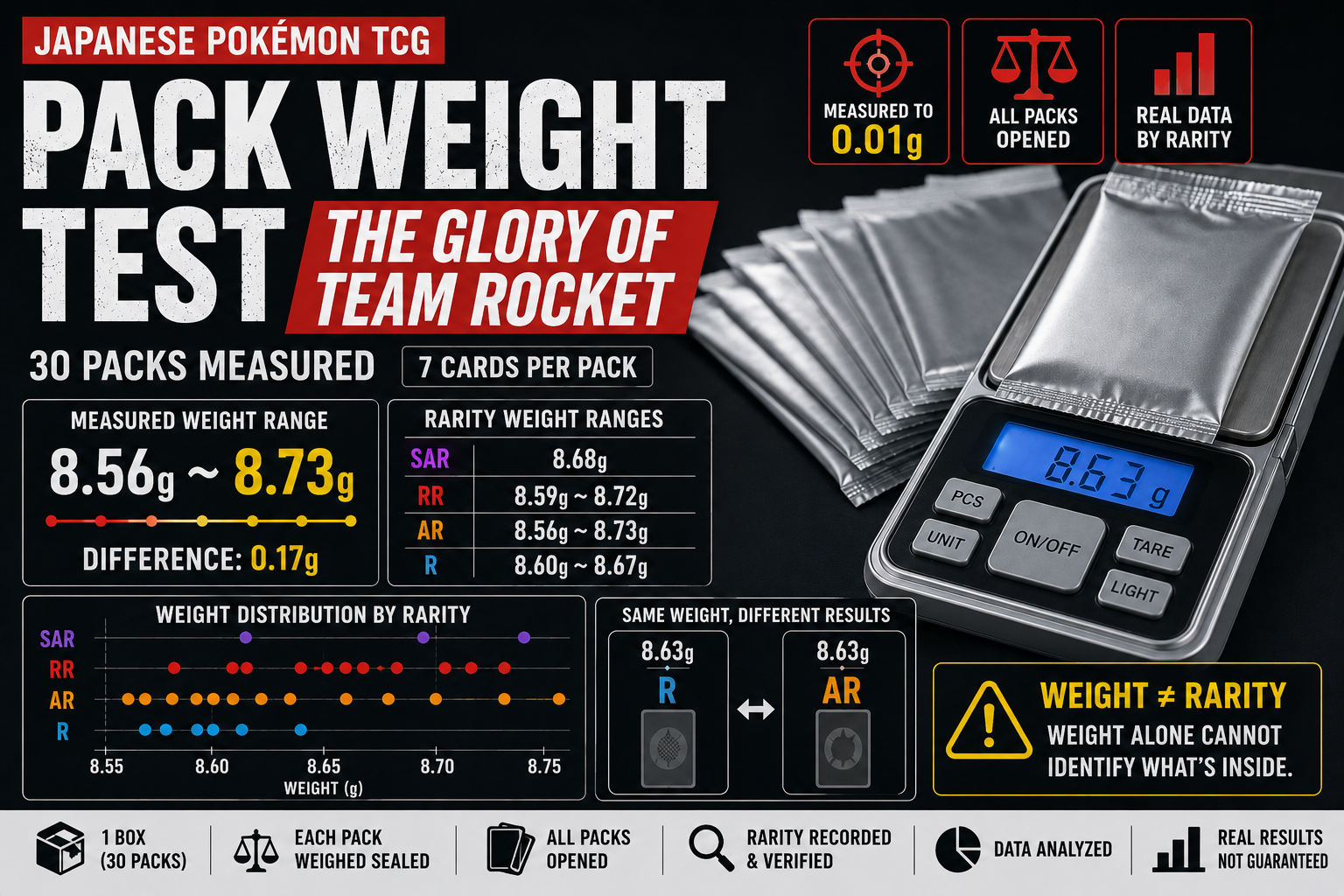
The image below summarizes the measured pack weights and the rarities found after opening them.
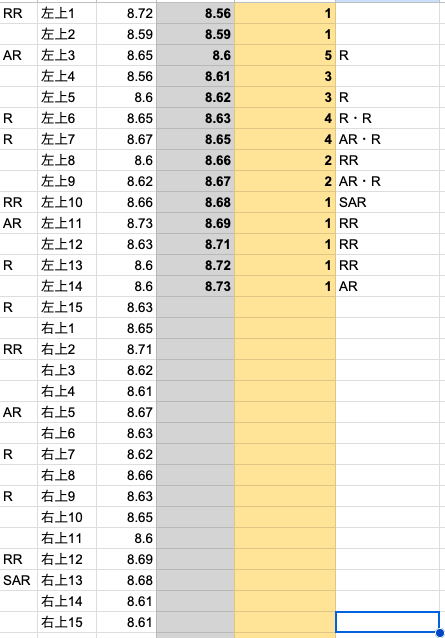
The weight ranges recorded for each rarity were as follows.
| Rarity | Measured Weight | Main Result |
|---|---|---|
| SAR | 8.68g | One SAR was found toward the heavier side of the box |
| RR | 8.59g–8.72g | Distributed across a wide range from lighter to heavier packs |
| AR | 8.56g–8.73g | The widest weight distribution observed in this test |
| R | 8.60g–8.67g | Mostly found around the middle of the overall weight range |
AR cards had the widest range in this test, appearing between 8.56g and 8.73g.
An AR appeared at both the lighter and heavier ends of the booster box.
There was therefore no unique weight range that could be used to identify an AR pack.
What the Measurements Showed
The main findings from this booster box were:
- The SAR was found at 8.68g
- RR packs ranged from 8.59g to 8.72g
- AR packs ranged from 8.56g to 8.73g
- R packs ranged from 8.60g to 8.67g
- Both an R and an AR were found at 8.63g
- The weight ranges of different rarities overlapped significantly
- Higher pack weight did not consistently correspond to higher card rarity
Some relatively heavy packs did contain the SAR or an RR.
However, AR cards appeared across almost the entire measured range.
An AR was found at 8.73g, which was heavier than the pack containing the SAR at 8.68g.
This shows that the heaviest pack does not necessarily contain the highest-rarity card.
SAR Pack Weight
The SAR found in this booster box came from a pack weighing 8.68g.
Within this box, 8.68g was toward the heavier end of the distribution.
The card's surface treatment or the combination of cards inside the pack may have contributed to the overall weight.
However, only one SAR was observed in this test.
There were also packs heavier than 8.68g that contained RR or AR cards instead.
The only conclusion that can be made from this measurement is:
In this booster box, the SAR was found in a pack weighing 8.68g.
It does not mean that packs around 8.68g are likely to contain an SAR.
It also does not mean that simply selecting a heavier pack would identify one.
RR Pack Weight
RR cards were found in packs weighing between 8.59g and 8.72g.
Some RR packs were among the heavier packs in the booster box, but RR cards were also found at 8.59g.
This means RR cards were not concentrated within one narrow weight range.
The RR range also overlapped with SAR, AR, and R results.
No weight range unique to RR packs was identified in this test.
AR Pack Weight
AR cards showed the widest weight distribution of all the rarities recorded in this booster box.
They appeared in packs weighing from 8.56g all the way to 8.73g.
An AR was found in a relatively light 8.56g pack, while another appeared at 8.73g near the maximum end of the measured range.
Possible reasons for these differences include variations in printing, surface treatment, the other cards inside the pack, and the foil wrapper.
However, the data from one booster box is not sufficient to determine the exact cause of those differences.
An AR and an R were also both found at 8.63g.
This makes it clear that AR packs could not be accurately identified by weight alone.
R Pack Weight
R cards were found between 8.60g and 8.67g.
Most appeared around the middle of the overall weight distribution.
However, their weight range overlapped heavily with AR and RR packs.
A particularly useful example is 8.63g.
- 8.63g: R
- 8.63g: AR
Even when measuring to the nearest 0.01g, exactly the same displayed weight produced two different rarity results.
Therefore, R packs could not be reliably distinguished from other rarities using weight alone.
The Same Weight Can Produce Different Results
One of the most important findings in this test was that identical displayed weights did not always produce identical opening results.
At 8.63g, both an R and an AR were recorded.
Even if differences in foil treatment or printing affect the weight of individual cards, variations in the wrapper and the other cards inside the pack can cause the final pack weights to overlap.
There may also be differences below the resolution of the digital scale.
For example, two packs both displayed as 8.63g could theoretically have slightly different actual weights at the 0.001g level.
Because multiple variables affect the final measurement, packs showing the same weight on a 0.01g scale cannot reliably be distinguished before opening.
Can The Glory of Team Rocket Packs Be Weighed to Identify Rarity?
In this booster box, the SAR and some RR cards appeared in relatively heavy packs.
However, the complete dataset also showed:
- AR cards spread across a very wide range from 8.56g to 8.73g
- An AR appeared at 8.73g, heavier than the SAR pack at 8.68g
- RR cards ranged from 8.59g to 8.72g
- Both an R and an AR appeared at 8.63g
- The weight ranges of all recorded rarities overlapped substantially
- Multiple factors other than rarity may affect total pack weight
Based on these results, pack weight showed some tendencies within this booster box, but it could not accurately distinguish SAR, AR, RR, and R packs.
The measurements published here should be viewed as data recorded after opening every tested pack, not as weight thresholds for selecting “hit packs.”
What to Know When Buying Loose Japanese Packs
When buying loose packs through marketplace apps, auction sites, or person-to-person transactions, it can be difficult to know how those packs were stored or handled before sale.
This does not mean that every loose pack has been sorted or searched.
However, the buyer may have no practical way to independently verify what happened to the packs beforehand.
If your goal is simply to enjoy opening packs, consider purchasing through sources where the product's origin and condition can be more easily verified.
- Use official sales channels when available
- Buy from established trading card shops or major retailers
- Use official lottery or made-to-order sales when available
- Check seller ratings and return conditions when using person-to-person marketplaces
- Do not make a purchase decision solely because a product is significantly cheaper than the normal market price
A seller describing packs as “unsearched” does not necessarily provide an objective way for the buyer to confirm their previous handling.
Choosing a reliable seller and understanding the condition of the product is more important than relying only on such claims.
Summary of the Test Results
After weighing all 30 unopened packs from this booster box, the recorded rarity ranges were:
- SAR: 8.68g
- RR: 8.59g–8.72g
- AR: 8.56g–8.73g
- R: 8.60g–8.67g
- Both an R and an AR were found at 8.63g
- AR cards appeared across both the lighter and heavier ends of the box
- The measured ranges of different rarities overlapped significantly
- Pack weight alone could not accurately identify the rarity inside
Some heavier packs did contain the SAR or RR cards.
However, AR cards appeared across a very broad range, and different rarities were recorded at exactly the same displayed weight.
Therefore, pack weight can be useful as experimental data when comparing packs within a specific booster box, but it cannot be treated as a reliable standard for identifying the rarity inside an unopened pack.
This is the first pack-weight dataset I am publishing on the English version of tekemero.com.
I plan to continue testing additional Japanese booster boxes under the same conditions and compare how the weight distributions differ between sets.