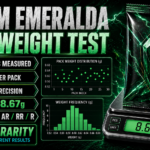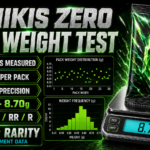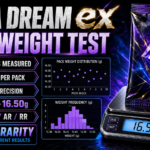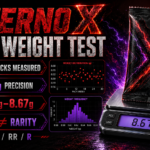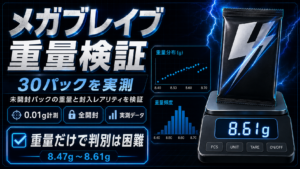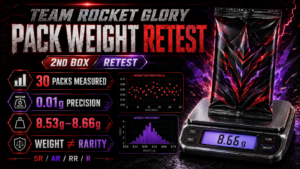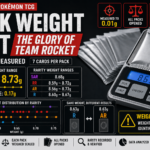

In the previous test, I measured all 30 packs from a Japanese Mega Brave booster box and compared pack weight with SR, AR, RR, and R results.
This time, I tested Mega Symphonia.
For this experiment, I used all 30 five-card packs from an unopened Japanese Mega Symphonia booster box that I purchased myself.
Every sealed pack was weighed individually to the nearest 0.01g. I then opened all 30 packs and recorded the relationship between pack weight and card rarity.
The overall result was similar to Mega Brave in some ways.
The SR cards in this booster box were found in relatively heavy packs.
However, SR, AR, RR, and R cards also overlapped within similar weight ranges.
Therefore:
Although some weight tendencies were visible within this booster box, pack weight alone could not accurately identify the rarity inside an unopened pack.
This article documents an experiment into whether what is commonly known as “pack weighing” can actually distinguish card rarity.
It is not intended to encourage weighing packs in stores, selecting packs by weight before purchase, or selling packs that have been sorted by weight.
Pack weight may be affected by the foil wrapper, the cards themselves, printing and manufacturing variation, humidity, the measuring environment, and scale accuracy.
The measurements shown here are results from this specific booster box.
They should not be treated as universal standards for other booster boxes, production batches, or loose packs.
Test Conditions
The test was conducted under the following conditions.
- Product: Japanese Mega Symphonia expansion
- Purchase format: unopened booster box
- Number of packs measured: 30
- Cards per pack: 5
- Every pack was weighed while sealed
- Measurement precision: 0.01g
- Location: normal indoor environment
- All 30 packs were opened after weighing
- Card rarity was recorded after opening
Like Mega Brave, Mega Symphonia uses a five-card pack format, and no Mirror Holofoil cards were observed in this booster box.
This made the overall pack configuration relatively straightforward for comparing weight differences.
However, this test represents only one booster box.
More boxes would need to be measured before determining whether the same weight patterns are reproducible.
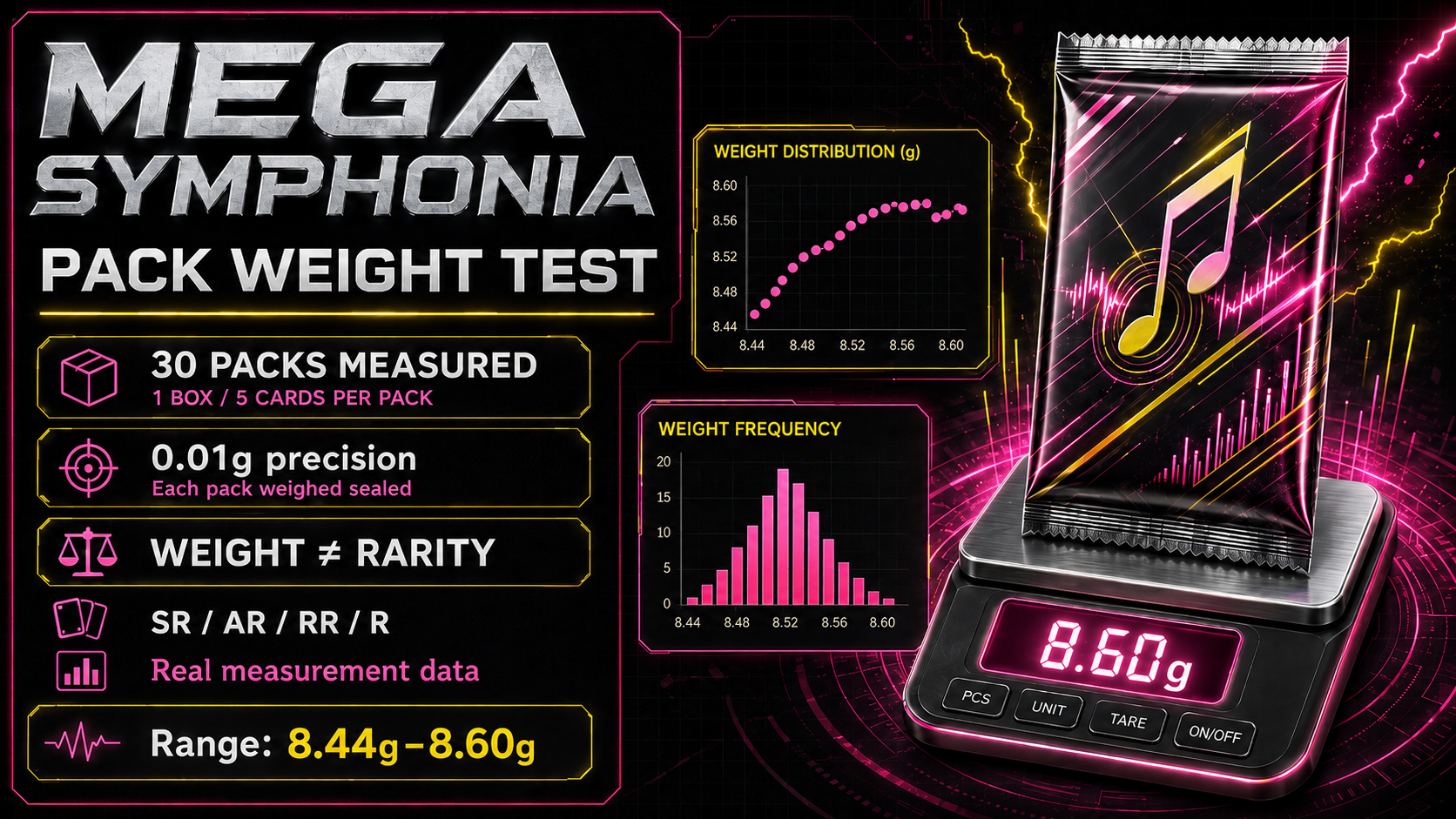
Mega Symphonia Pack Weight Results: 30 Packs Measured
The 30 packs measured in this test ranged from:
Measured range: 8.44g–8.60g
Packs containing higher-rarity cards: 9
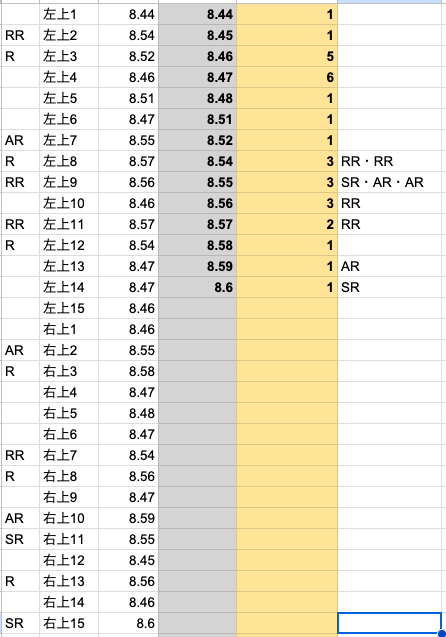
The packs were distributed between 8.44g and 8.60g.
In this booster box, higher-rarity cards such as SR, AR, and RR were mainly found in packs weighing approximately 8.54g or more.
However, different rarities appeared at identical or very similar weights.
The results did not form a simple pattern where heavier packs consistently contained higher-rarity cards.
There was a visible tendency, but the weight ranges of multiple rarities overlapped substantially.
Results by Weight Range
The opening results from this booster box can be grouped into several approximate weight ranges.
✅8.44g–8.48g: Mainly common and uncommon cards
No higher-rarity cards were observed within this range in this booster box.
However, this applies only to the 30 packs measured in this experiment.
It does not mean that every Mega Symphonia pack weighing 8.48g or less contains only common or uncommon cards.
✅8.49g–8.53g: Some R cards appeared
Most packs in this range contained standard cards, although some R cards were observed.
The differences were small enough that no clear boundary could be identified for determining whether an R card was present before opening.
✅8.54g–8.58g: R, RR, AR, and SR results overlapped
This was the range with the greatest amount of rarity overlap.
R, RR, AR, and even an SR were all observed within this relatively narrow weight range.
Because very different opening results appeared at the same or similar weights, there was no practical way to distinguish the rarities using weight alone.
✅8.59g–8.60g: AR and SR appeared
The heaviest pack in this booster box weighed 8.60g and contained an SR.
An AR was also found at 8.59g.
This means that even packs at the very top of the measured weight range did not exclusively contain SR cards.
Can SR Packs Be Identified by Weight?
The two SR cards observed in this booster box came from packs weighing 8.55g and 8.60g.
The 8.60g pack was the heaviest of all 30 packs measured.
This result is somewhat similar to the previous Mega Brave test, where the SR cards were also found toward the heavier end of the distribution.
However, the other SR in Mega Symphonia appeared at only 8.55g.
AR, RR, and other rarities were also found around the same weight.
The only conclusion supported by this test is:
In this booster box, the SR cards were found in packs weighing 8.55g and 8.60g.
This does not mean that the heaviest pack will always contain an SR or that packs above a particular weight can reliably be identified as SR packs.
Can RR and AR Be Distinguished by Weight?
The RR and AR cards observed in this booster box appeared at the following weights.
- RR: 8.54g, 8.56g, and 8.57g
- AR: 8.55g and 8.59g
Looking only at these numbers, the AR cards may appear to be distributed slightly toward the heavier side.
However, the differences are only around 0.01g to 0.05g.
Differences this small may be affected by:
- The foil wrapper
- Individual card variation
- Printing differences
- Humidity
- The measuring surface
- Scale measurement error
SR and R cards were also found within similar weight ranges.
Therefore, RR and AR could not be reliably distinguished using pack weight alone.
The Middle Weight Range Contained Multiple Rarities
One of the most important observations in this test was the amount of overlap between 8.54g and 8.58g.
Within this narrow range, I observed:
- R
- RR
- AR
- SR
This means that two packs separated by only 0.01g could produce very different results.
Even packs showing the same displayed weight may also differ below the 0.01g resolution of the scale.
For example, two packs both displayed as 8.55g could still have slightly different actual weights at the 0.001g level.
For that reason, apparently precise measurements should not be treated as exact rarity thresholds.
Can Japanese Mega Symphonia Packs Be Weighed to Identify Rarity?
Some tendencies were visible in this booster box.
SR and AR cards were generally found toward the heavier half of the measured distribution.
However, the full dataset also showed:
- The two SR cards appeared at very different weights: 8.55g and 8.60g
- R, RR, AR, and SR all appeared between 8.54g and 8.58g
- An AR appeared only 0.01g below the heaviest SR pack
- Differences of around 0.01g may be affected by manufacturing and measurement variation
Based on these results, pack weight showed some relationship with rarity within this booster box, but it could not accurately identify higher-rarity cards before opening.
The measurements in this article should be viewed as data recorded after fully opening one booster box, not as weight thresholds for selecting “hit packs.”
Comparing Mega Symphonia With Mega Brave
Mega Brave and Mega Symphonia were tested under very similar conditions.
Both products use five-card Japanese booster packs, and 30 packs from one unopened booster box were measured in each test.
The SR results were:
- Mega Brave: SR cards appeared at 8.58g and 8.61g
- Mega Symphonia: SR cards appeared at 8.55g and 8.60g
Both tests showed SR cards toward the heavier side of the overall distribution.
However, Mega Symphonia also produced an SR at 8.55g, where several other rarities were present.
The two tests also shared several other characteristics.
- AR and RR appeared within similar weight ranges
- Different rarities overlapped substantially
- The heaviest part of the range did not exclusively contain SR cards
- Pack weight alone could not accurately identify rarity
In Mega Brave, the SR results were more concentrated toward the heavier end.
In Mega Symphonia, the SR results were spread more widely across the distribution.
This comparison is based on only one booster box of each product.
The measured ranges should therefore not be treated as universal differences between Mega Brave and Mega Symphonia.
Summary of the Mega Symphonia Pack Weight Test
After measuring and opening all 30 Japanese Mega Symphonia packs, the main results were:
- The measured range was 8.44g–8.60g
- The SR cards appeared at 8.55g and 8.60g
- RR cards appeared at 8.54g–8.57g
- AR cards appeared at 8.55g and 8.59g
- Several rarities overlapped within the middle weight range
- Pack weight alone could not accurately identify the rarity inside
The test again showed some relationship between pack weight and rarity.
However, the weight ranges of SR, AR, and RR overlapped enough that no reliable threshold could be identified.
Another booster box may also produce a different weight distribution.
No SAR or MUR cards were observed in this booster box.
If these rarities appear in future tests, I plan to record whether their pack weights differ meaningfully from the other rarity levels.
This is the fifth pack-weight dataset published on the English version of tekemero.com.
With both Mega Brave and Mega Symphonia now tested under nearly identical conditions, the data also provides an initial comparison between the two Japanese five-card booster products.
I will continue adding measurements from other Japanese sets to see whether the same patterns appear again.